When brown patches appear and a repair tech blames the mowing crew for cracked pipes and sheared heads, physics and Texas irrigation code tell a different story.
The $1,000 Misconception: A Real North Texas Scenario
A local North Texas homeowner recently noticed large sections of their lawn turning brown in the middle of summer. An irrigation repair contractor was called out, uncovered several damaged spray heads and cracked underground pipes, and presented an invoice close to $1,000 with a simple diagnosis: "The mowing crew destroyed your system."
It is completely understandable why homeowners feel frustrated when handed a massive repair bill. However, rotary mower blades spin on a fixed, flat horizontal plane between 2.5 and 3.5 inches above the ground, while string trimmers maintain grade along the turf canopy. When irrigation components fail, the culprit is almost never operator negligence—it is a combination of soil dynamics, absent flexible swing joints, aggressive wildlife, or non-compliant installations.
Understanding the mechanical realities of irrigation components separates genuine maintenance accidents from underlying system deficiencies.
1. The Mechanics of "Funny Pipe" and Head Maneuvering
For a mower blade to strike a sprinkler body, the plastic must be physically protruding into the cutting canopy. The difference between a head that survives for decades and one that gets clipped comes down to how it connects to the underground lateral line.
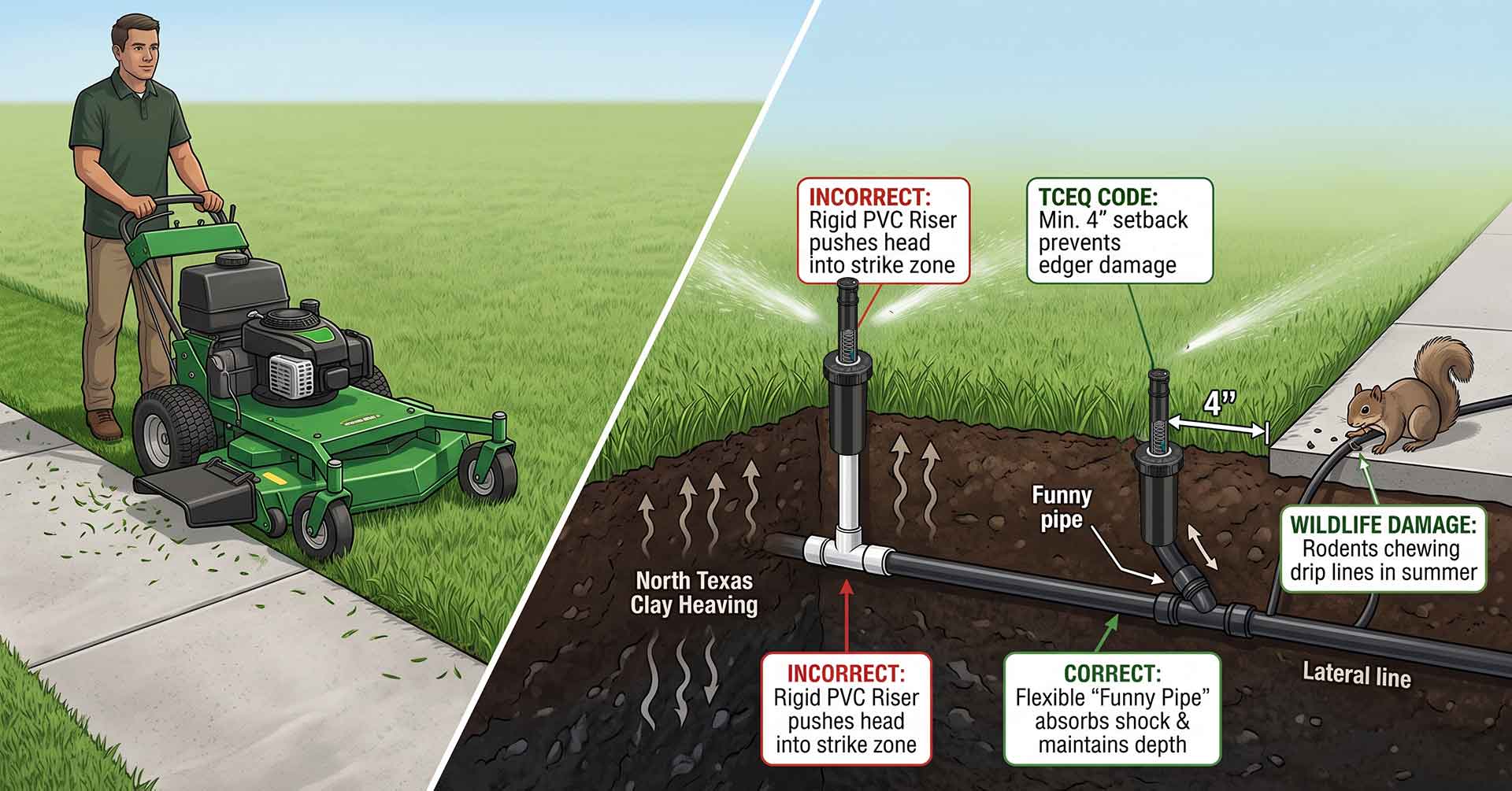
- The Rigid PVC Mistake: In cheap or rushed installations, installers thread sprinkler canisters directly onto rigid vertical PVC nipples. When North Texas Blackland clay expands during rain or contracts during drought, that rigid pipe is pushed upward. Because rigid PVC has zero give, the head is forced straight into the strike zone. If a tire or foot presses on it, the brittle PVC snaps off underground.
- The Flexible Swing Joint ("Funny Pipe") Solution: Professional installations connect the sprinkler canister to the lateral pipe using a 6-to-12-inch section of flexible polyethylene tubing with spiral barb elbows (commonly called funny pipe or a swing joint assembly).
- Dynamic Maneuvering: Funny pipe acts as an articulated, multi-directional joint. It allows you to maneuver the sprinkler head in any direction—adjusting its pitch, shifting its horizontal placement away from concrete, or resetting its height perfectly flush with the soil grade without re-trenching the main line. If a mower passes directly over a head mounted on funny pipe, the assembly simply flexes downward into the soil bed and returns undamaged.
2. The 4-Inch Hardscape Rule (TCEQ Compliance)
When perimeter heads along driveways, sidewalks, or curbs are constantly clipped by steel edging blades or string trimmers, the installation is often in direct violation of state code.
Under Texas Commission on Environmental Quality (TCEQ) Title 30 TAC §344.62, landscape irrigation systems must maintain a minimum 4-inch setback from impervious surfaces (sidewalks, curbs, and driveways) unless specialized low-volume or directional heads are engineered to eliminate overspray.
- Why the Buffer Matters: Beyond preventing municipal runoff, that 4-inch gap provides the necessary mechanical clearance for lawn maintenance tools. Steel edger blades slice vertically into the turf boundary along concrete borders to create clean, crisp edges.
- The Result of Non-Compliance: If an installer places a pop-up head flush against the concrete edge, that head sits directly in the path of the edging blade. An edge-adjacent head is an installation deficiency, not a trimming error.
3. Summer Gouges and Chewed Drip Lines: The Wildlife Factor
When irrigation technicians discover serrated gouge marks on sprinkler caps or shredded drip tubing, they frequently misidentify the damage as blade strikes.
During extreme North Texas summer droughts, surface water disappears, leaving wildlife severely dehydrated. Rats, mice, squirrels, and gophers can hear and smell the pressurized water pulsing through subterranean systems.
- Chewed Drip Tubing: Rodents will aggressively gnaw through exposed half-inch poly drip tubing and emitter lines in landscape beds to access water.
- Gouged Sprinkler Caps: Squirrels regularly chew on the textured plastic rims and soft rubber wiper seals of pop-up heads. A mower blade leaves a clean, high-velocity shear; irregular, serrated teeth marks indicate rodent activity.
- The Solution: Drip tubing should never sit exposed on top of the soil. Secure lines with ground staples and maintain a consistent 2-to-3-inch protective layer of hardwood mulch to insulate the tubing from rodents and UV degradation.
4. Why Routine Mowing Cannot Physically Break Underground Pipes
Another persistent misconception is that mowers crack underground PVC pipes when maintaining the lawn. When evaluated against equipment specs and depth-of-bury standards, this is physically impossible.
- Lightweight Walk-Behind Deployment: Over 98% of residential property maintenance is performed with lightweight commercial walk-behind mowers. These 21-inch commercial units weigh under 150 lbs, distributing minimal ground pressure across each of the tires—often exerting less downforce per square inch than the footprint of an adult walking across the lawn.
- Depth of Bury Standards: Per TCEQ rules (§344.63), lateral irrigation pipes must be buried at least 6 inches deep, and constant-pressure mainlines must sit a minimum of 12 inches below finished grade. A walk-behind mower rolling across the surface cannot transfer load force through 6 to 12 inches of compacted clay soil to crush a rigid pipe.
- The Real Culprits: Underground pipes fail due to point-loading against buried construction rocks, violent shear forces from shifting Blackland clay during extreme droughts, aggressive tree root intrusion, or degraded glue joints that finally separate under hydraulic shock (water hammer) when valves snap shut.
Homeowner Action Checklist
Before paying for repeated repairs or assuming your maintenance crew is at fault, perform this quick audit:
- The Sole Test: Walk perimeter edges with the system turned off. Glide your shoe across the lawn. If your sole strikes a rigid plastic rim protruding above the soil line, that head needs to be lowered.
- Retrofit with Swing Joints: When replacing broken heads, require the technician to install them on flexible funny pipe assemblies rather than rigid threaded PVC risers.
- Inspect the Setback: Measure the distance between your edge heads and the concrete. If heads sit less than 4 inches from the pavement, use the flexibility of a swing joint to maneuver them inward.
- Test the Retraction Spring: Run each zone for 30 seconds and shut it off. If a riser sticks up 1 to 2 inches instead of snapping flush into the canister, the internal spring has failed and the head must be rebuilt or replaced.
- Bury Exposed Drip Tubing: Check flower beds to ensure all black and brown drip poly lines are buried under 2 to 3 inches of mulch to keep rodents away.