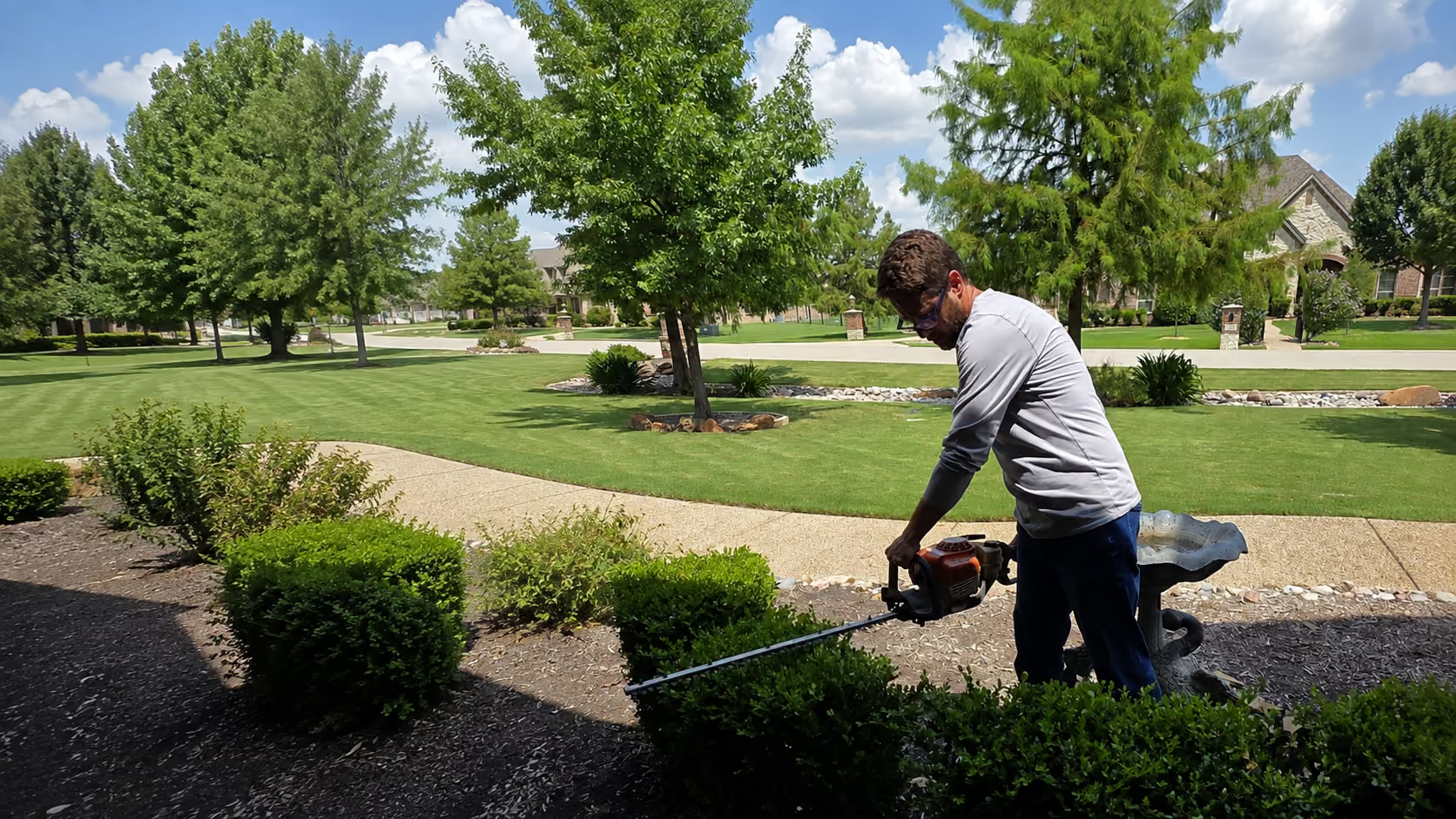
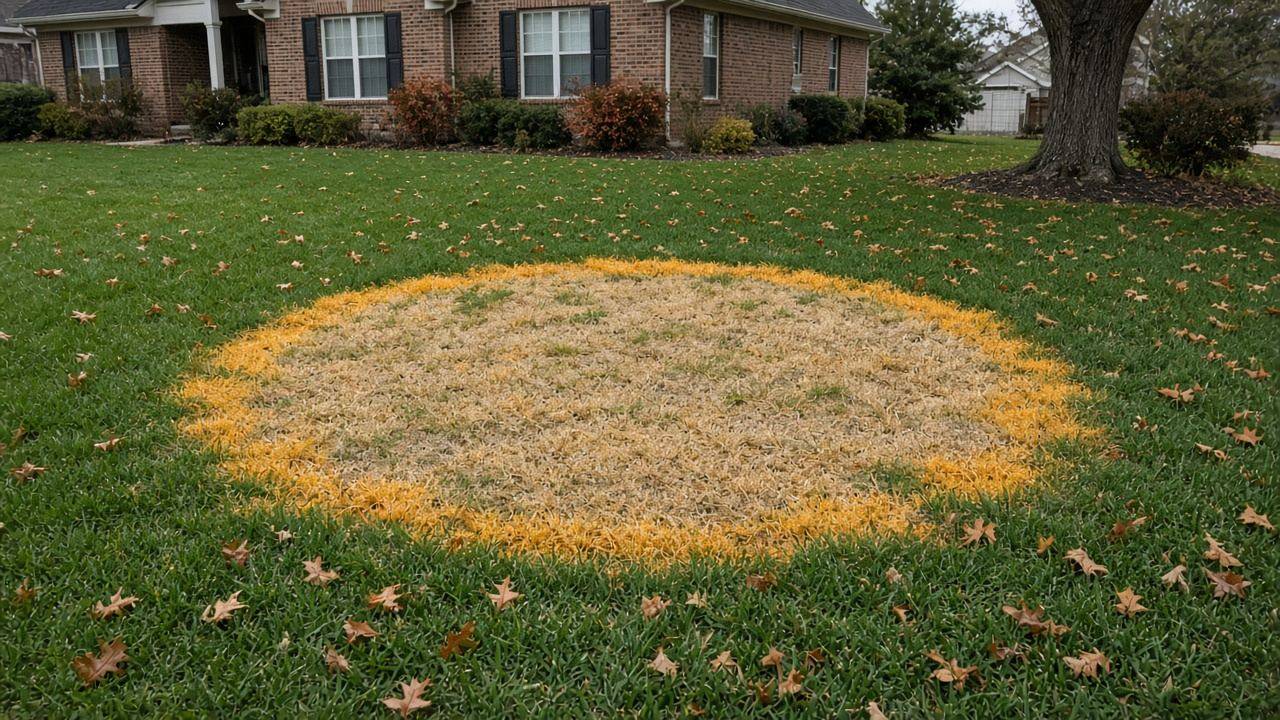
Round brown patches with an orange edge in fall St. Augustine are usually large patch fungus, not mower damage. Here's how to tell the difference and what to do about it in DFW.
Every fall we get some version of this call from homeowners in Frisco, McKinney, Plano, and Allen: "There's a big brown circle in my St. Augustine, and it showed up right after the mowers came through." It's a fair thing to suspect. But a perfect yellow-brown ring that keeps growing over a couple of weeks is almost never mower damage. In North Texas, it's usually a fungus called large patch.
Short answer: brown circles in St. Augustine that appear in fall are most often large patch disease, not the mower. Mower problems leave straight lines, scalped strips, or ragged tips. Large patch leaves round, spreading patches with an orange or yellow edge.
What large patch actually is
Large patch is a fungal disease (caused by Rhizoctonia solani) that attacks warm-season grasses, especially St. Augustine and zZoysia. It lives in the soil year-round and flares up when nights cool off and the ground stays wet, which is exactly what DFW gets from October into early winter, and again in spring.
The fungus rots the base of the grass blades where they meet the runner. That's why the patch looks like it's dying from the inside out, and why the edge of the circle looks orange or bronze where the grass is still being attacked.
Mower damage or large patch? How to tell
Why it shows up in fall in DFW
Large patch likes cool, wet weather. In North Texas, that usually means the stretch after the first real cool front, when nights drop into the 50s and 60s, fall rains roll through, and sprinklers are still running on a summer schedule. Grass also grows slower in fall, so it can't outgrow the damage the way it would in June.
A few things make it worse:
- Too much water. Watering in the evening or on a summer schedule keeps the base of the grass wet overnight.
- Fall nitrogen fertilizer on St. Augustine. Late-season nitrogen feeds soft new growth the fungus loves.
- Poor drainage and thick thatch. Low spots and spongy layers hold moisture right where the disease starts.
- Scalping. Cutting St. Augustine too short stresses it going into the cool season.
What to do if you have it
- Cut back the water. Switch the controller to a fall schedule, water only in the early morning, and skip it after a good rain.
- Hold off on nitrogen. Save feeding for late spring when St. Augustine is actively growing.
- Keep mowing at normal height. Don't drop the deck to "clean up" the patch. That just stresses the healthy grass around it.
- Mark the edge. Push a few golf tees or flags at the outer ring. If it moves past them in a week or two, the disease is still active.
- Call a licensed turf treatment provider if patches keep spreading. Fungicides work best as prevention in early fall, before the circles show up, and they're regulated products in Texas.
Can mowing spread it?
The fungus is already in the soil, so mowing doesn't create large patch. Wet clippings and mud on equipment can move infected material around, though. If you have an active patch, it's reasonable to ask your crew to mow that area last when the grass is wet, and to bag or blow clippings off it. Leaves piling up on a patch keep it damp too, so clearing them helps.
The good news: St. Augustine usually fills those circles back in as it warms up in late spring, as long as the runners underneath survived. Keep the water down, keep mowing at the right height, and give it time.
The DFW bottom line
If the brown spot is round, has an orange edge, and the blades pull loose at the base, it's large patch, not your mower. Fix the watering, skip fall nitrogen, and keep a steady mowing schedule through fall. In North Texas, that's every other week in November and about once a month from December through February.