Warm-season grasses like Bermuda often turn brown, stemmy, and uneven during peak summer growth. Learn why raising your mower height actually worsens the problem and how a controlled Height-of-Cut (HOC) reset restores a thick, carpet-like lawn.
TL;DR
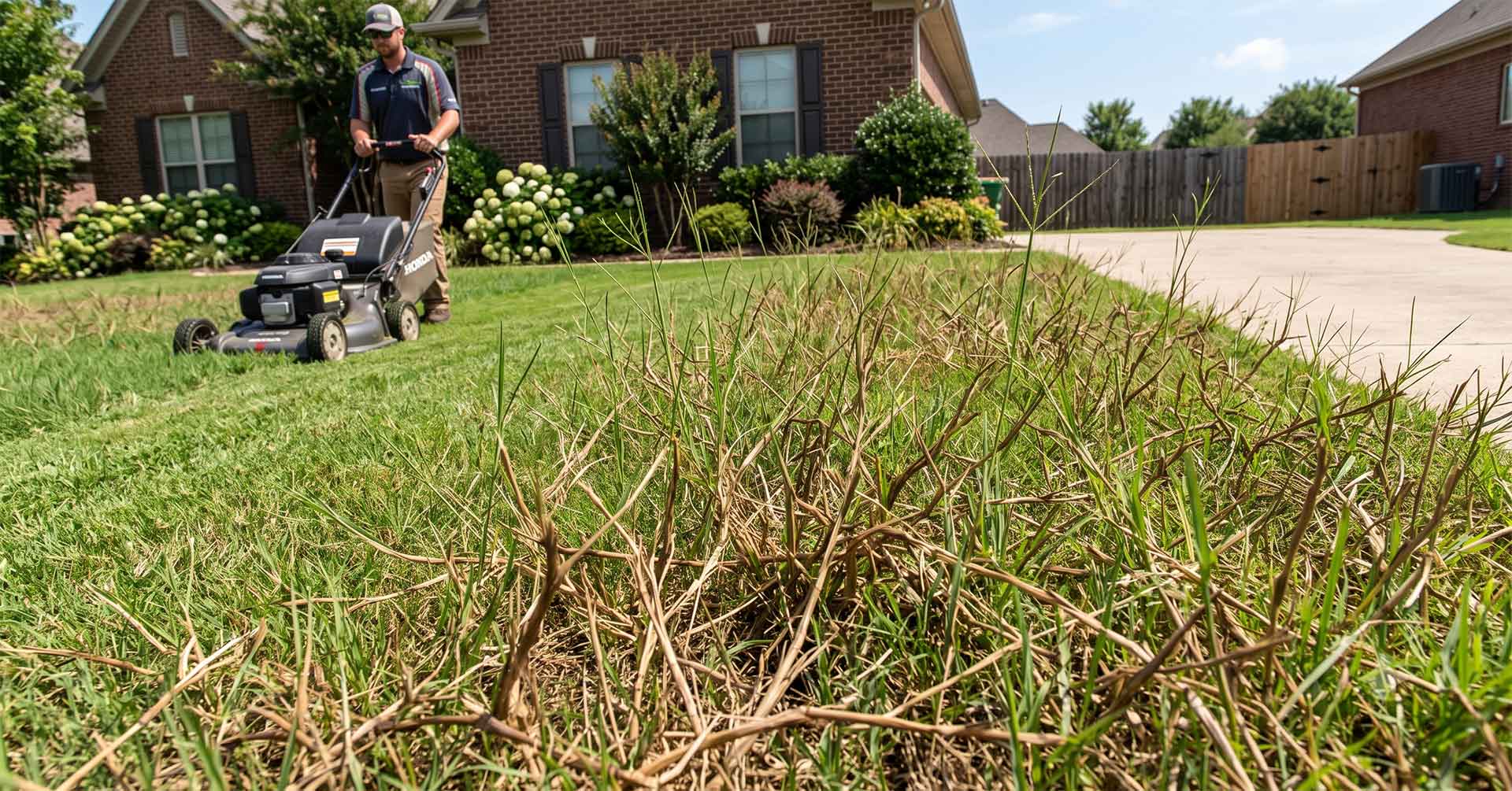
When warm-season grass (especially Bermuda) grows too tall between cuts, the lower stems turn brown and woody while the tops stay green. The next mow then removes the green layer and exposes those stiff brown stalks, leaving the lawn looking lanky, patchy, and uneven. A controlled Height-of-Cut (HOC) reset removes the elongated stems so fresh green growth comes back denser and more uniform. Prevention comes from the right height for the grass type + frequent enough mowing so the lawn never gets stemmy in the first place. “Just cut it on the highest setting” usually makes the problem worse on Bermuda and Zoysia.
If your lawn looked okay last week but now looks thin, stemmy, and uneven after a mow, you’re not alone—and it’s usually not because the crew simply “cut it wrong.”
In the heat of summer, warm-season grasses grow fast. When growth outpaces the mowing schedule (or when the deck sits too high for too long), two things happen at once:
- The lower stems get shaded out, turn brown and woody, and lose the soft green tissue.
- The canopy becomes irregular—taller in some spots, thinner in others—so the mower doesn’t ride evenly. High spots get cut harder, low spots get left longer, and the overall surface ends up looking uneven and patchy instead of smooth and interwoven.
When the mower finally comes through, it shears off the green tops and suddenly reveals the stiff brown stalks underneath. The result is that lanky, uneven appearance with visible brown stems and little of the dense, carpet-like interweaving you want.
Many customers then say, “Just mow it at the highest setting next time.” That request makes sense if you’re thinking about cool-season grasses… but on Bermuda (and to a large degree Zoysia), it often makes the problem worse by encouraging even more vertical, stemmy growth.
Here’s what’s really going on—and the professional fix that restores density and evenness.
What’s Actually Happening: The Stemmy, Uneven Lawn
Warm-season grasses like Bermuda produce most of their green leaf tissue near the top of the plant. As the canopy gets taller, the lower portion of each stem is starved of light. Those lower stems stop producing chlorophyll, turn brown and stiff, and stop contributing to a dense surface.
At the same time, the taller growth is rarely perfectly uniform. Some areas grow faster than others because of slight differences in soil, water, or traffic. The mower then has to deal with an irregular canopy: it cuts deeper into the taller sections and leaves more behind in the shorter ones. The combination of exposed brown stems + inconsistent cutting heights is what creates the lanky, uneven look.
This shows up most often when:
- Mowing intervals stretch longer than ideal during peak growth
- The height of cut drifts upward over the season
- Homeowners request the highest setting, thinking taller automatically equals healthier
The lawn doesn’t just turn brown—it loses the tight, interwoven surface that makes a good cut look clean and even.
The Fix: A Height-of-Cut (HOC) Reset
A height-of-cut reset is a controlled, intentional lower cut designed to remove the elongated brown stems and reset the canopy so new growth comes in greener and denser from the base.
How it works:
- The mower is dropped significantly below the normal maintenance height (often a notch or two below the long-term target height).
- All clippings are bagged and removed so the stemmy material doesn’t smother new growth.
- The lawn temporarily looks more open and brown while new shoots emerge.
- Once the fresh growth reaches the desired height, regular mowing resumes at the proper setting. Because the old brown stems have been cleared, subsequent cuts stay in green tissue and the turf begins to knit laterally again—improving both color and surface evenness.
Recovery is typically noticeable in 1–3 weeks under good growing conditions. The end result is a tighter canopy with better interweaving and far less of the lanky, uneven appearance.
This is not the same as accidental scalping from a low spot or dull blade. It is a deliberate reset performed when the lawn has gotten ahead of the mowing cycle.
For best results, perform an HOC reset only during active peak growth (late spring through mid-summer), and keep soil moisture consistent for 7–10 days post-reset to protect exposed stems from summer heat and speed up green recovery.
How This Differs by Grass Type
Bermuda
Bermuda benefits the most. It spreads aggressively through stolons and rhizomes and recovers quickly from a proper HOC reset. Bermuda densifies best when maintained relatively low (commonly 1–1.5 inches for many residential lawns). Keeping it tall encourages exactly the vertical, stemmy growth that creates both the brown stalks and the uneven surface. A mid-summer HOC reset is a standard and effective tool for Bermuda.
Zoysia
Zoysia tolerates a moderate HOC reset better than St. Augustine, but it recovers more slowly than Bermuda. Stay more conservative with the drop in height. Medium- to coarse-textured varieties are typically kept in the 1.5–2.5 inch range. An overly aggressive cut can leave the surface open longer, so timing and aftercare matter.
St. Augustine
St. Augustine is the least suited to aggressive scalping or deep HOC resets. Its stolons sit higher in the canopy, and cutting too low can damage the growth points. Recommended heights are much taller (typically 3–4 inches). The classic “brown stalk + lanky unevenness” pattern is less common in the same form as Bermuda, but letting it get too tall and then cutting hard still stresses the plant and can create an uneven look. Gradual height reduction over multiple visits and strict adherence to the one-third rule are safer.
How to Prevent It From Happening Again
The best long-term solution is consistency matched to the grass type:
- Maintain the correct height range for your grass (Bermuda lower, St. Augustine higher).
- Never remove more than one-third of the blade in a single mowing. If the lawn has gotten tall, plan a staged reduction or a deliberate HOC reset rather than one hard cut.
- Increase frequency during peak summer growth—Bermuda especially may need service every 5–7 days (or more often) when it’s growing hard.
- Use sharp blades for clean, consistent cuts. Torn tissue and irregular canopies both contribute to an uneven appearance.
- Keep moisture consistent after any reset so new growth can establish evenly.
- Avoid the “always highest setting” approach on Bermuda and most Zoysia. Taller is not automatically healthier for these grasses—density, lateral growth, and surface evenness all suffer when the canopy is allowed to become excessively tall and stemmy.
What Mowing Best Recommends
When a lawn shows the classic summer pattern of lanky growth, visible brown stalks, and uneven surface after cutting, we evaluate the grass type, current height, overall health, and recent growth rate. In many Bermuda cases, a planned HOC reset followed by a return to the proper maintenance height produces a noticeably denser, more uniform result within a couple of weeks. For Zoysia we adjust the aggressiveness of the reset. For St. Augustine we focus on frequency and gradual correction rather than a deep drop.
If you’ve been asking for the highest setting because the lawn looked thin or uneven after previous cuts, that request is understandable—but it often perpetuates the cycle on Bermuda. The better path is the right height + the right frequency + an occasional reset when growth gets ahead of the schedule.
A healthy, dense warm-season lawn doesn’t come from always cutting high. It comes from matching the cut to how the grass actually grows—so the surface stays tight, interwoven, and even.
Have questions about your specific lawn or want us to assess whether an HOC reset makes sense right now? Reach out. We’re happy to explain exactly what we’re seeing and the best next step for your grass type.