Protect your North Texas home from shifting Blackland clay without destroying grass. Learn why overhead sprinklers cause turf rot, calculate the exact water volume and runtime required to close foundation perimeter gaps safely, and apply a 4-day drip protocol designed for expansive clay soils.
Late summer across North Texas puts homeowners in a difficult bind. Triple-digit temperatures bake native Blackland clay, causing the soil to shrink and pull away from concrete slab foundations.
In a rush to stop foundation shifting, homeowners often turn to their sprinkler systems, running lawn zones for long cycles or leaving garden hoses flooding the perimeter. While the slab gets temporary relief, the adjacent St. Augustine turf suffocates, turns yellow, and develops destructive root rot.
Protecting your foundation without killing your lawn comes down to understanding how local clay soil holds moisture, separating your watering zones, and applying the right hydration schedule.
Diagnosing the Problem: Dry Foundation vs. Overwatered Turf
Foundation Soil Shrinkage (Under-Watered Slab)
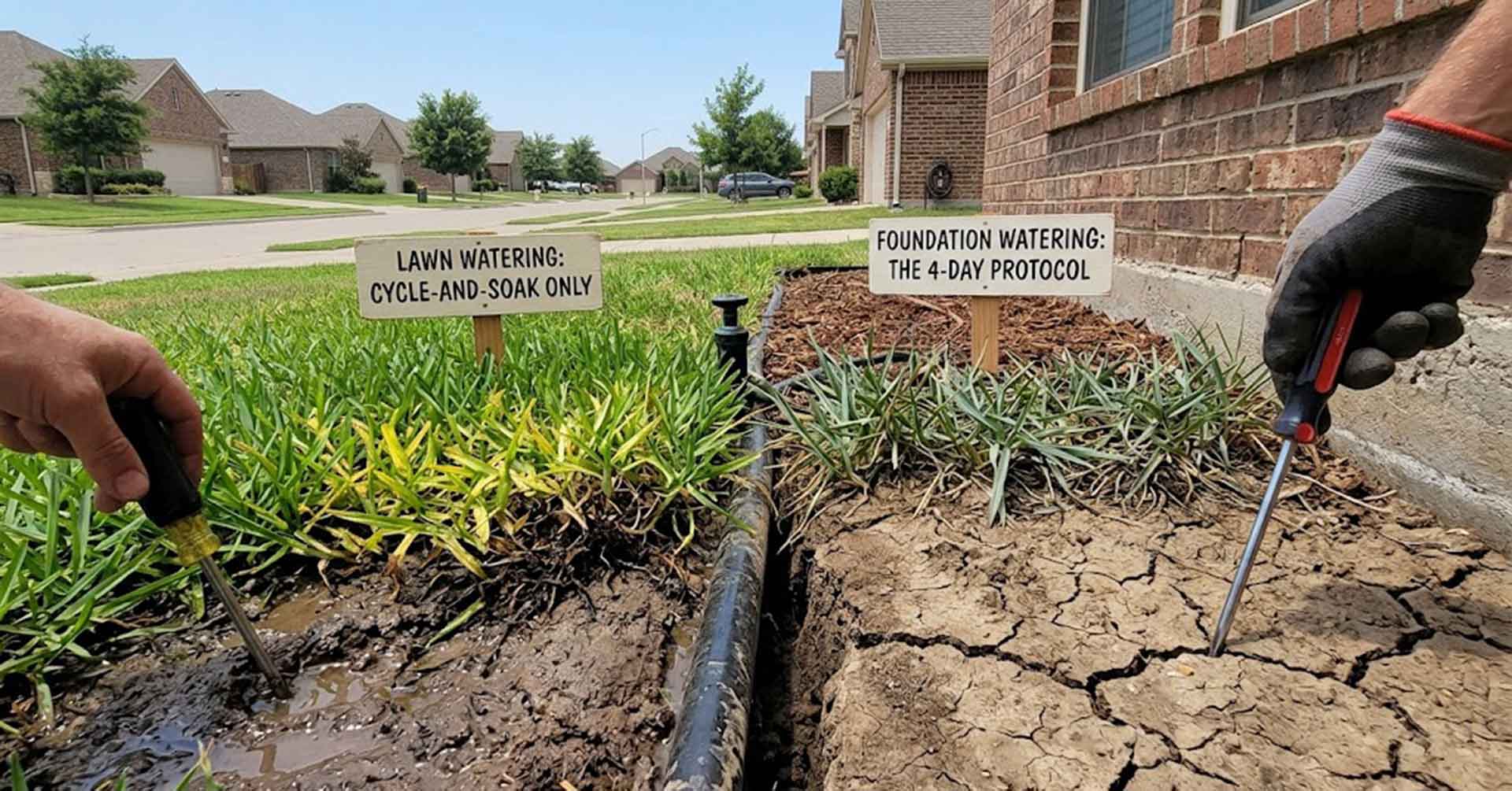
- Soil Condition: The ground pulls 1 to 1.5 inches away from the concrete slab, opening deep fissures in hard, cracked clay.
- Turf Appearance: Grass blades turn a dull, blue-gray color and fold inward along the center vein to conserve water.
- Root Health: Stolons (runners) stay firmly rooted in the dry ground and resist pulling.
Overwatered St. Augustine Grass (Saturated Root Zone)
- Soil Condition: The ground feels soggy, stays muddy 24 hours after watering, or gives off a sour, swampy smell.
- Turf Appearance: Large irregular yellow patches (chlorosis) form across the lawn, the turf canopy thins out, and dark brown water lesions appear on lower leaf blades.
- Root Health: Turf runners pull out of the wet mud with zero effort, exposing dark, mushy, and rotted roots damaged by fungal diseases like Take-All Root Rot or Large Patch.
Why Lawn Sprinklers Cannot Fix a Shrinking Foundation
The expansive clay soil across Collin, Dallas, and Denton counties acts like a dense sponge. To keep a slab foundation stable, water needs to reach 12 to 18 inches below ground along the exterior concrete beam.
Overhead lawn sprinklers are designed only to wet the top 4 to 6 inches of topsoil where grass roots live. Running standard sprinkler zones long enough to push moisture a foot deep into heavy clay creates standing surface water. This drowns the root system of St. Augustine turf, cutting off oxygen and allowing fungal pathogens to take over.
The Math: Fixing a 1 to 1.5-Inch Foundation Gap
When dry clay pulls 1 to 1.5 inches away from your foundation down to a depth of 12 inches, restoring soil volume requires calculated watering:
1. Water Volume Needed
North Texas Blackland clay needs roughly a 20% increase in soil moisture to expand back to its stable state. For a 12-inch-deep by 15-inch-wide perimeter soil area, this requires 1.87 gallons of water per linear foot of foundation (about 280 gallons total for an average 150-foot perimeter).
2. Drip Line Flow Rate & Sizing
Rather than thin 1/4-inch micro-tubing, foundation systems require commercial-grade 17mm (1/2-inch internal diameter) drip line with built-in, pressure-compensating 1.0 GPH emitters spaced 12 inches apart. This configuration delivers exactly 1.0 gallon per hour per linear foot, meaning the system needs roughly 1 hour and 50 minutes (approx. 2 hours) of total runtime to deliver the required 1.87 gallons.
3. Why Running the Hose Continuously Fails
Letting a drip line run continuously for 2 hours in a single session will not close the gap and can actually damage your home:
- Water Runoff: Once heavy clay gets wet on top, its absorption rate drops drastically. Excess water bypasses the dry soil, running straight down the open crack to the bottom of the footing.
- Slow Clay Expansion: Clay swells at a microscopic mineral level, a process that takes 48 to 72 hours to fully complete.
- Slab Settling Risk: Flooding the area turns the subsoil into soft mud, temporarily weakening the ground that supports the weight of your foundation beam.
4. The 4-Day Progressive Hydration Protocol
To safely deliver the required ~1 hour and 50 minutes of water using a 1.0 GPH commercial drip line:
- Days 1 to 3: Run foundation drip lines for 30 minutes once per day in the early morning (1.5 hours total).
- Day 4: Run for a final 20-minute session (yielding ~1 hour and 50 minutes total runtime).
- Days 5 to 7: Turn the drip line off and let capillary action draw moisture through the clay. The soil will swell outward naturally and close the gap over the next several days without waterlogging your turf.
Best Practices for North Texas Homeowners
- Install Dedicated 17mm Foundation Drip Lines: Lay commercial 17mm tubing with 1.0 GPH emitters 12 to 18 inches out from the foundation wall. Cover the line with 2 to 3 inches of hardwood mulch to prevent solar evaporation and keep emitters cool.
- Use Cycle-and-Soak for the Lawn: Set your overhead sprinkler zones to run in short, repeated bursts (such as three 4-minute cycles spaced 45 minutes apart) so water soaks into the clay without running off.
- Use the Screwdriver Test: Push a 6-inch metal screwdriver into the soil once a week. If it cannot push past 1 inch, the foundation zone needs water. If it slides in with moderate resistance, moisture is balanced. If it slides in effortlessly and pulls out covered in slick mud, turn off lawn watering immediately.
Long-Term Management: Why Baseline Moisture Wins
Guidance from Texas A&M AgriLife Extension stresses that managing North Texas Blackland clay requires keeping soil moisture consistent, rather than reacting with heavy watering only after large cracks appear. Extreme moisture swings—shifting back and forth between bone-dry shrinkage and sudden flooding—cause the greatest foundation movement and create the exact stress conditions that trigger lawn diseases.
Supporting your foundation drip zones with smart lawn maintenance habits keeps both your slab and turf protected:
- Raise Your Mowing Height: Keep St. Augustine cut at 3.5 to 4 inches during the summer heat. Taller grass shades the soil surface, cooling the ground and cutting down perimeter evaporation.
- Maintain Mulch Beds: Keep 2 to 3 inches of mulch over your foundation drip lines to shield the tubing and soil from direct afternoon sun.
- Adjust Seasonally: Reduce drip run times as temperatures drop heading into fall and winter. Lower evaporation rates mean the soil holds moisture longer, and cutting back run times prevents cold, soggy soil pockets from developing along the foundation.
Managing foundation moisture and turf irrigation as two separate systems ensures your home stays structurally sound while your St. Augustine lawn stays thick and healthy.