When a blade of grass leans directly against a fence picket, downspout, or playset leg, cutting it requires physical contact. Here is the science of routine maintenance friction—and how to protect your yard fixtures.
When you hire a professional lawn care team, you expect two things every single week: a uniform, level cut across your turf, and sharp, manicured edges around every single boundary.
Achieving that clean look requires heavy-duty commercial equipment. But there is a fundamental law of physics that every homeowner and property manager eventually encounters: if grass grows directly against an object, cutting that grass requires physical contact with the object.
Over a 30-to-40-week mowing season, that repeated contact leads to what the landscape industry classifies as routine wear and tear.
Understanding where the boundary lies between careless damage and unavoidable maintenance friction helps keep your property looking pristine while saving you money, frustration, and surprise repair bills.
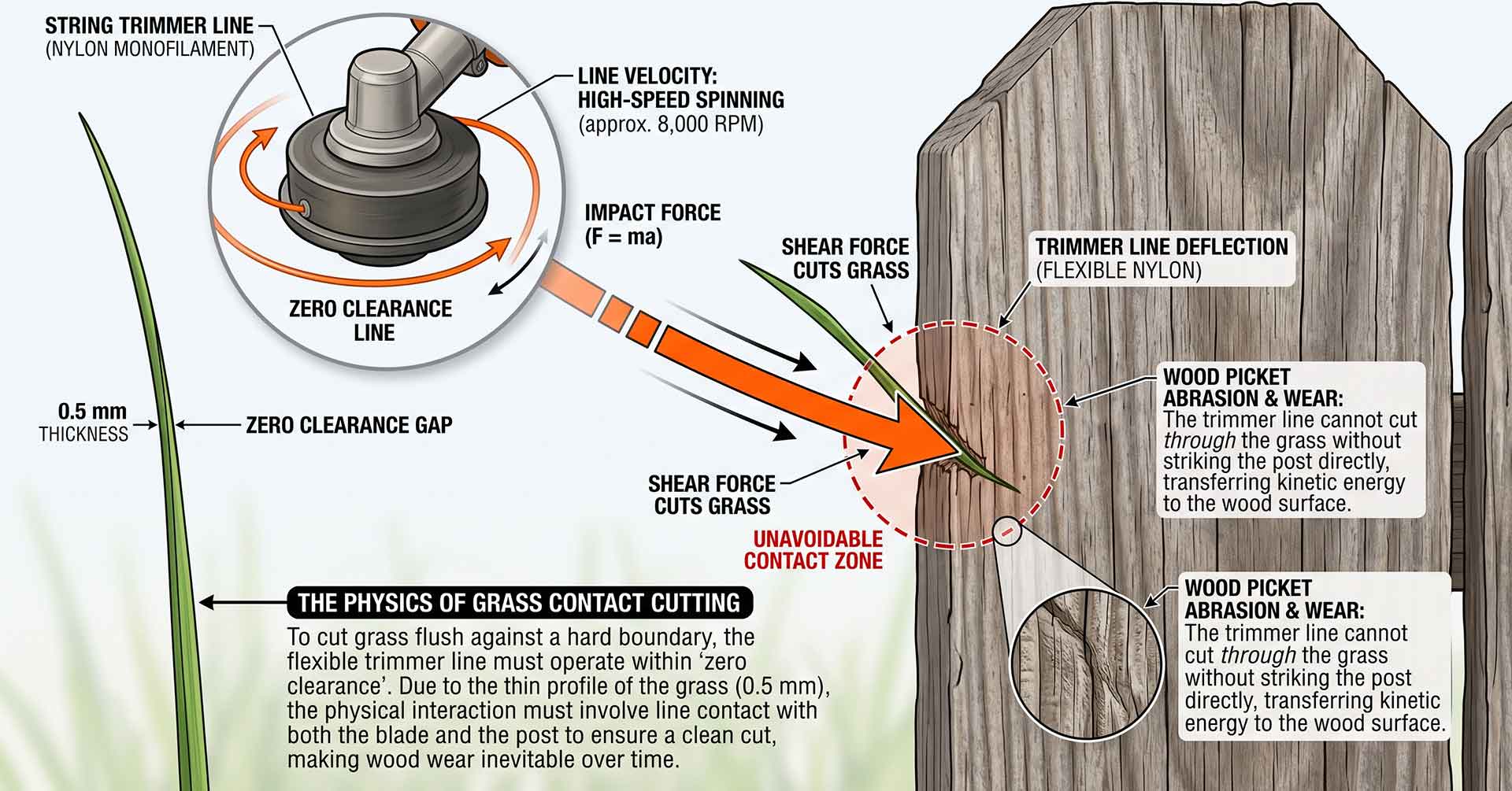
The Physics of the 0.5 mm Grass Blade
Imagine a single blade of warm-season Bermuda grass. It is roughly 0.5 millimeters thick, growing out of the soil and leaning flat against the face of a cedar fence picket, a plastic drain tube, or a swing set post.
There is zero air gap between that blade of grass and the object behind it.
To cut that 0.5 mm blade of grass cleanly, maintenance crews use commercial string trimmers. These machines spin a specialized 0.095-inch heavy-duty nylon line at 7,000 to 9,000 RPM.
- Option A: The operator stops the spinning line 1 inch away from the object to avoid touching it. The result? A messy, ragged tuft of tall grass left standing against the post, making the entire property look unfinished.
- Option B: The operator cuts the grass flush with the rest of the turf. To do that, the flexible nylon line must physically make micro-contact with the surface the grass is resting against.
When a trimmer head passes that surface once a week for several seasons, that high-velocity friction will inevitably leave witness marks, faint scuffs, or light fraying.
The Silent Multiplier: Texas UV Rays and Brittle Plastics
In North Texas, equipment friction is only half the story. The real culprit behind broken items in the lawn is photodegradation from extreme UV exposure.
During long DFW summers, objects sitting out in 100°+ heat absorb punishing ultraviolet radiation. Over 1 to 3 years, polymers lose their plasticizers. Flexible, impact-resistant plastics become as brittle as dried pasta. A light brush from a rubber mower tire or a tap from a nylon trimmer line—forces that wouldn't leave a smudge on brand-new material—can easily shatter sun-baked items.
Here are the most common property items that experience unavoidable wear and tear when placed directly in the turf line:
1. Soft Woods and Turf-Level Structures
- Fence Posts and Board-on-Board Pickets: Cedar is a naturally soft wood. Weekly trimming along fence lines gradually scuffs the bottom inch of the pickets. On board-on-board fencing, the overlapping pickets create 1-inch recessed pockets. Grass blades love these sheltered gaps. Clearing them requires angling the trimmer line directly into the wood corners.
- Wooden Playsets and Swing Sets: When playsets are anchored directly inside the turf rather than in a dedicated mulch pit, the support legs take constant line friction every time the perimeter is manicured.
- 15+ Year-Old Aging Gates: Gates that have endured 15 years of Texas heat and shifting clay often suffer from dry-rotted 2x4 framing, rusted hinges, and dragging latch pins. Simply unlatching, swinging open, and latching an aged gate to access the backyard with a mower can cause brittle pickets or loose hardware to give out.
2. High-Risk Plastics and Conduit in the "Strike Zone"
- Black Corrugated Downspout Extensions: These thin, accordion-style plastic tubes are notorious for breaking. Left lying exposed across the lawn, they bake in the sun until their paper-thin ridges crack at the slightest touch.
- Exterior Irrigation Wiring PVC Conduit: Frequently installed along exterior garage brick or foundation walls, thin-wall PVC conduit runs down directly into the grass line to protect low-voltage valve wiring. Once baked brittle by the sun, trimmer line clearing grass at the foundation can crack the plastic.
- Solar Landscape Lights in the Grass: Inexpensive plastic solar stake lights belong inside landscape beds—not in the turf. A plastic light placed 2 inches from the sidewalk sits directly in the path of edger blades and mower decks.
- Sewer and Septic Cleanout Caps: When cleanout pipe ports stick up 1 to 2 inches above the soil grade, commercial mower decks (set at 2.5 to 3.5 inches) and trimmer heads have to navigate an obstacle course. If these caps are sun-bleached, they can crack easily when clipped.
3. Yard Obstacles and Foundation Borders
- Garden Hoses and Plastic Splash Blocks: Leaving garden hoses coiled on the lawn forces crews to either move hot, pressurized hoses (which can pull on outdoor spigots) or trim blind around them. Unanchored plastic gutter splash blocks shifting into the turf line are equally vulnerable.
- Flimsy Rabbit and Chicken Wire Fencing: Wire mesh installed around beds or across access pathways creates an obstacle for 130-pound commercial walk-behind mowers. Lifting heavy machinery over thin wire inevitably bends and degrades the mesh over time.
- Spalling Foundation Concrete: Along older slab foundations, moisture and age cause the outer surface of the concrete to flake or spall. Trimming grass growing tight to an unmanicured foundation line can dislodge already-crumbling mortar or loose cement chips.
How to Protect Your Yard: The Homeowner Defense Plan
You don't have to choose between a shaggy, untrimmed lawn and damaged fixtures. With a few simple design adjustments, you can completely isolate your yard items from routine equipment friction:
- Adopt the "Bed Rule" for Fragile Fixtures: Move all plastic solar lights, decorative stakes, and loose garden hoses out of the turf and place them at least 6 to 12 inches inside mulched landscape beds.
- Install Mulch or River Rock Collars: Create an 8-to-12-inch border of mulch or crushed rock around fence corners, wooden playset legs, and downspouts. When grass cannot grow against an object, a string trimmer never has to touch it.
- Bury Downspouts and Protect Conduit: Replace surface corrugated tubes with thicker buried PVC lines that terminate in pop-up emitters. For exposed wiring conduit on garage walls, install heavy-duty Schedule 80 PVC or a metal sleeve at the ground level.
- Cut Cleanouts Flush: If your sewer cleanout caps protrude above ground, have a plumber or handyman trim the PVC riser so the cap sits completely flush with the top of the soil or elevated above the grass canopy.
A Partnership in Property Care
Our goal is always to deliver a crisp, sharp cut without incident. However, when thin plastics, soft wood, and aged fixtures live directly inside the active mowing zone, natural friction is an inevitable mechanical reality.
By establishing small buffer zones around vulnerable yard items, you protect your property investments, keep your yard looking polished, and ensure your weekly lawn care remains completely smooth and worry-free.