Discover why non-retracting sprinkler stems are the single most common repair in routine lawn care, why they’re invisible in tall grass, and how our zero-hassle approach keeps your yard running smoothly.
There is nothing more frustrating than stepping outside to admire a freshly cut lawn, only to spot a sheared sprinkler nozzle or a riser missing its cap.
If this has ever happened to you, we understand the immediate sinking feeling. You invest time, money, and care into your property, and seeing damaged equipment is aggravating.
Here is something surprising from industry data: across residential landscape maintenance, non-retracting sprinkler stems are statistically the single most frequently reported damage item.
It happens across every neighborhood, with every professional maintenance team, and on lawns with both brand-new and seasoned systems. Because we believe in total transparency and keeping your service completely stress-free, here is the science behind why this happens, why our team often doesn’t even know contact occurred, and how a quick 60-second check can eliminate the problem for good.
The Stealth Culprit: The "Sticky" Stem
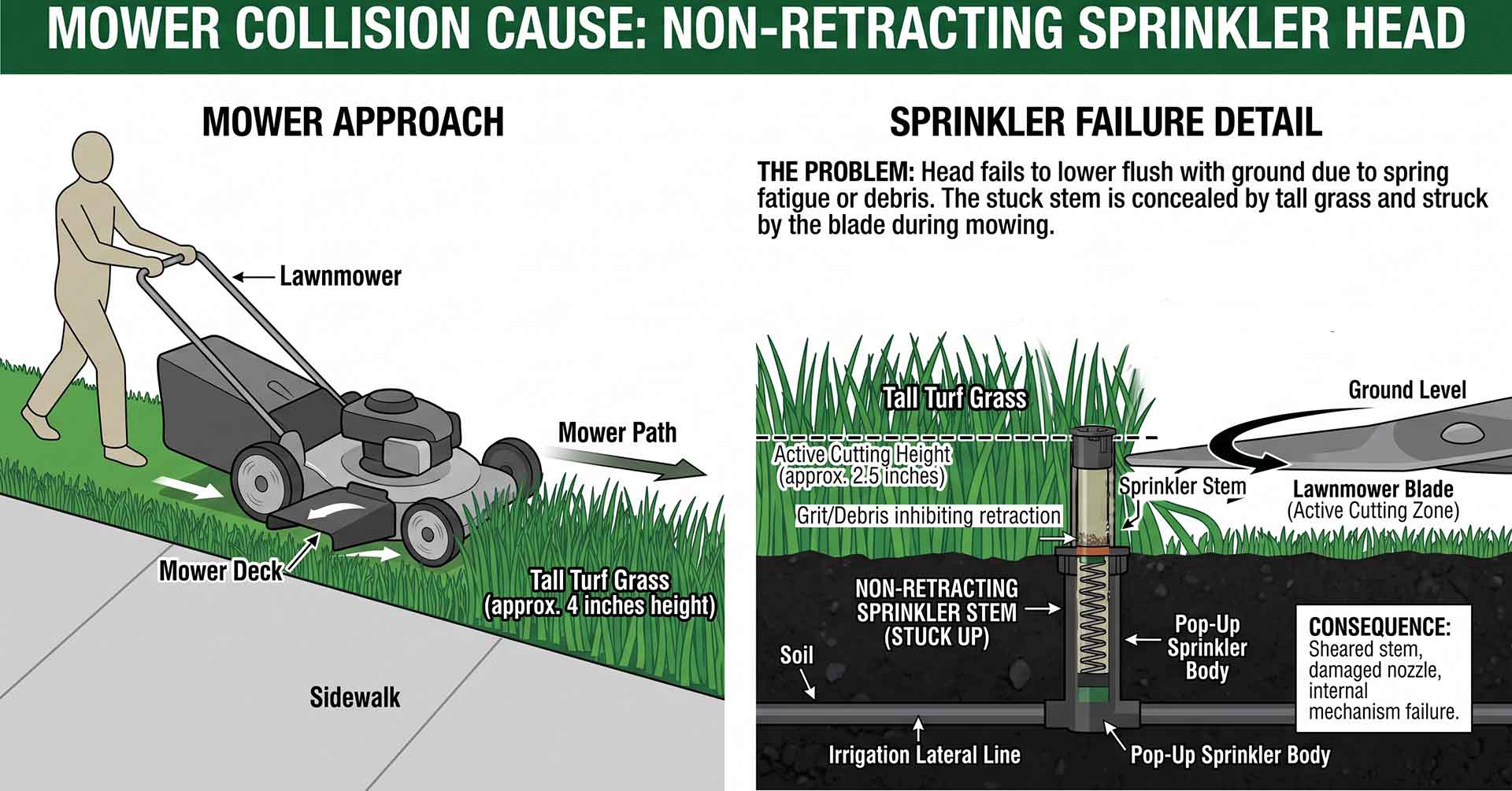
Pop-up sprinkler heads are simple mechanical devices. When your controller starts a zone, water pressure overcomes an internal recoil spring and pushes a plastic stem 3 to 6 inches up into the air. When the zone turns off and water pressure drops, that internal spring is designed to pull the stem back down flush into the body beneath the ground.
In a perfect world, heads drop every single time. But North Texas yards present tough conditions:
- Fine Silt and Clay Grit: Our local clay soil and natural windblown dust work their way around the rubber wiper seal at the neck of the canister. Over time, that fine grit creates friction.
- Spring Fatigue: After hundreds of watering cycles under triple-digit summer heat and mineral-heavy tap water, the stainless steel internal spring slowly loses its recoil strength.
- Turf Runner Pinching: Aggressive warm-season grasses like Bermuda naturally wrap runners around the rim of the canister, physically preventing the riser from dropping all the way home.
Instead of snapping down flush with the dirt, the stem drops halfway and hangs up—staying elevated 1 to 2 inches above the soil line or higher.
Why Crews Don’t Realize It Happened
A common question we hear is: "If the mower clipped my sprinkler, why didn't the crew let me know right then?"
The answer comes down to height, visibility, and mower physics:
- It Is Invisible from Above: Before a mow, your turf is at its week-long peak height (often 3 to 4 inches tall). A sprinkler stem sticking up 1.5 inches is completely concealed inside the thick green canopy. Looking down from above, an operator cannot see plastic hidden inside dense grass blades.
- Standard Deck Clearance: Our commercial walk-behind mowers are set to precise heights (usually 2.5 to 3.5 inches). Because the blades spin parallel to the ground, they will never touch a properly seated head. But if a riser is stuck in the upright position, it sits directly in the path of the blade.
- Instant, Silent Contact: Commercial blades spin at over 18,000 feet per minute. At that speed, a hardened steel blade slices through hollow, lightweight ABS plastic instantly—with virtually zero resistance. Combined with the sound of a commercial engine and required hearing protection, an operator literally cannot feel or hear when a sticking stem is clipped.
The crew moves on thinking they delivered a clean, routine cut, entirely unaware that a hidden riser was caught in the canopy.
Our Zero-Hassle Partnership
We never want our clients to feel unheard or left dealing with frustrating repairs alone. While maintenance crews cannot control soil grit or aging internal springs, we view caring for your property as an ongoing partnership.
- Open Communication: If you ever spot a clipped head after a service, simply send our office a quick photo. We track every report so we can identify problematic zones and note repeat low spots on your property profile.
- Courtesy Support: We are always happy to look at the issue with you, help determine whether a head is sitting too high or failing to retract, and provide courtesy service credits to make sure you are taken care of without hassle.
The 60-Second "Drop Test" (Homeowner Pro-Tip)
You don’t need a shovel, plumbing tools, or an expensive service call to keep your sprinkler heads safe. Most pop-up heads can be audited and refreshed in under a minute:
- Run a 30-Second Manual Test: Fire up your turf zones for just 30 seconds, then shut them off.
- Watch the Drop: Walk your yard and observe the heads. If any head stays propped up—or only drops when you gently tap it with your toe—the internal spring or wiper seal is worn out.
- The 60-Second "Gut Swap": You don't need to dig up the head or touch the underground pipes. Pop-up spray bodies (like Rain Bird 1800s or Hunter Pro-Sprays) have a threaded top ring. Simply unscrew the top cap with your hand, pull out the tired internal spring assembly, and drop in a fresh internal assembly (readily available at any home improvement store for around $3). Screw the cap back down, and your head will snap down instantly every time.
By keeping an eye on sticky stems and letting them drop flush, your irrigation system stays protected, water goes exactly where it belongs, and your lawn gets a crisp, worry-free cut every single week.