You’ll see the big trucks out in March, but should you be fertilizing your own lawn yet? Discover why mid-April is the safest bet for Bermuda and St. Augustine in North Texas.
If you live in the DFW metroplex, you’ve likely seen the lawn care trucks out since late February. Many commercial programs use a "Round 2" application of high-nitrogen blends like 21-7-14 during the tail end of winter.
This often leads homeowners to wonder: "If the pros are doing it, should I be out there with a spreader too?"
The answer depends on your goals—and your equipment. While commercial-grade, slow-release fertilizers are designed to "wait" for the grass to wake up, DIY applications in early spring can often cause more harm than good. Here is why we recommend the "Tax Day Rule" for most North Texas homeowners.
1. The Science of Soil Temperature
Warm-season grasses like Bermuda and St. Augustine are governed by soil temperature, not air temperature. They don't truly begin active "uptake" (eating) until soil temperatures are consistently above 65∘F.
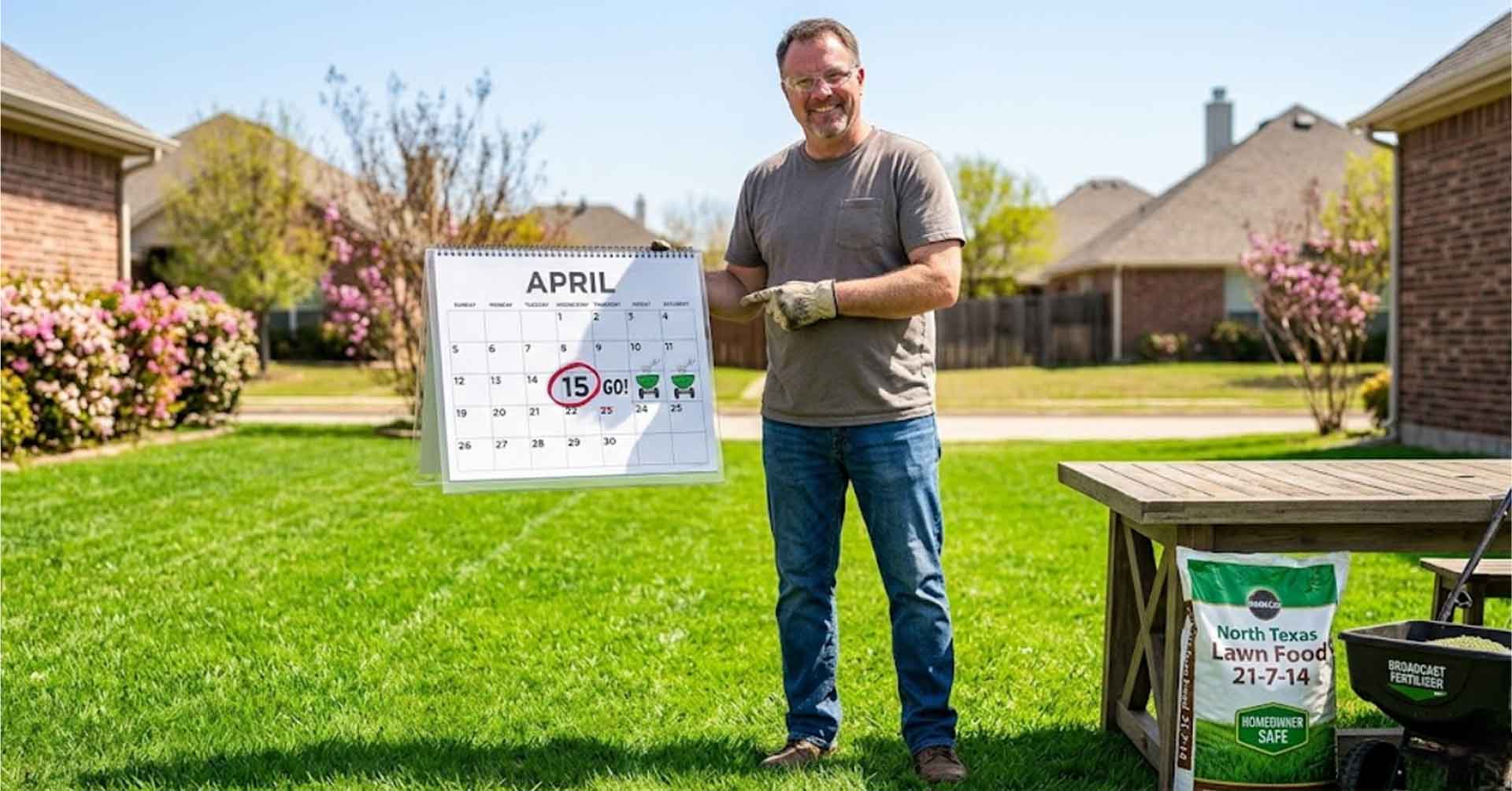
In North Texas, we often get a "false spring" in March followed by a late freeze. If you push a high-nitrogen fertilizer too early, you force the grass to produce tender new growth that can be easily killed by a 32∘F night. Waiting until mid-April (around Tax Day) ensures the roots are awake and the threat of a hard frost has passed.
2. Feeding the Grass, Not the Fungi
Early spring in North Texas is the prime season for Take-All Root Rot and Large Patch (Brown Patch). These fungal diseases love two things: moisture and nitrogen.
When you apply nitrogen to a lawn that isn't fully active, the grass can't absorb it all. That excess nitrogen sits in the damp thatch layer, essentially acting as "fast food" for lawn fungi. By waiting until the lawn is 50-75% green and growing, the grass can consume the nutrients immediately, leaving nothing behind for the fungi.
3. Commercial vs. Residential Timing
Professional companies often use specialized coatings on their fertilizer (like polymer-coated urea) that allow the nitrogen to release slowly over 8 to 12 weeks.
If you are buying standard fertilizer from a local garden center, it likely has a much faster release rate. Applying this in early March often leads to a massive "flush" of growth that forces you to mow twice a week, followed by a "crash" where the lawn turns yellow again by May.
The Mowing Best Strategy
A thick, healthy lawn is built on a partnership between the right nutrients and the right cut.
- Wait for the Mow: We recommend waiting until you have mowed your "active" green grass at least twice before applying your first round of fertilizer.
- The 21-7-14 Ratio: This is a fantastic "workhorse" blend for North Texas. The 21% Nitrogen fuels green-up, while the 14% Potassium strengthens the roots for the upcoming 100-degree summer days.
- Consistency Wins: Whether you fertilize in late March or mid-April, the most important factor is a consistent mowing height. Keeping your Bermuda at 2.5" or your St. Augustine at 3.5" allows the grass to shade its own roots and maximize the fertilizer you put down.
Keep in mind that these suggestions apply to most residential settings!